What Are Running Records? A Teacher Guide for Planning Instruction
Chances are, if yous teach the master grades, you lot accept to do running records. But what are running records, and how exercise they help you teach reading? Never fear, WeAreTeachers is here to explain it all.
What are running records?
Running records autumn under the reading assessments portion of your readers' workshop. They're function read aloud assessment (recall: fluency assessment) and part ascertainment. The goal of a running record is, outset, to see how the educatee is using the strategies you're educational activity in class, and second, to detect out if the student is set to advance in a reading-level system if your schoolhouse uses i (Reading A to Z, Fountas and Pinnell, and others). Thinking about instruction, when you combine a running tape with some analysis, you lot tin can address educatee mistakes and plan their adjacent steps.
When do I use running records?
Running records are used to collect information on young readers who are still reading aloud and working on basic skills (remember: those who are at reading levels aa–J). A running record captures both how well a student reads (the number of words they read correctly) and their reading behaviors (what they say and do as they read). At the start of the year, or when you offset working with a student, a running tape can help lucifer the student with books that are right for them. And then, yous can use subsequent running records to track the pupil'south progress.
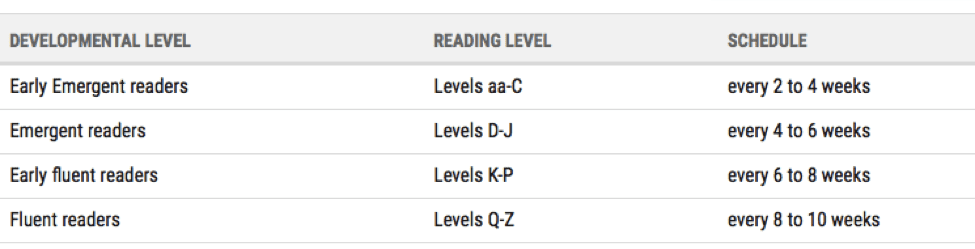
Once you do the first running tape, the time in between running records will depend on how well the child is progressing and what level they are reading. An emergent reader (using Reading A to Z levels aa–C, for example) will be assessed every two to iv weeks, while a fluent reader (level Q–Z) should exist assessed every eight to x weeks. Substantially, students who are learning the fundamentals are assessed more frequently than students who are working on fluency and higher-society comprehension.
Here's a sample running records cess schedule from Learning A–Z.
Why practise I do running records?
Skilful readers use what is happening in the text (meaning), cognition of language and grammar (structural), and visual cues (words and word parts) to read. Beginning readers are learning how to practise this, and then running records provide a style to detect how they are approaching text.
For any text that a child reads, running records help you answer these questions:
- What is the child'due south word reading and fluency? Or, can they read smoothly and accurately? (Get our free fluency posters hither.)
- Are they able to cocky-monitor and correct their mistakes while reading?
- Are they able to use meaning, structure, and visual cues to understand what they read?
- What do they do when they come up across a word they don't know? (Check out our list of vocabulary games.)
- Are they using strategies that you taught in form?
- How are they improving in their reading over time?
How do I do a running tape?
Every running record follows the same procedure:
- Sit down next to the child so yous can follow along with them as they read.
- Cull a passage or book that is at the student's estimate reading level. (If yous're incorrect on the level, you can adjust up or downwards to get the correct fit. If you're not focusing on level, choose something that the child is working on in grade.)
- Tell the child that they will read out loud equally you heed and jot some notes about their reading.
- Equally the child reads, keep a record by using a running record form (a typed paper of the same passage the educatee is reading). Mark the page by putting a checkmark higher up each word that is read correctly and marking errors. Hither is an overview of how to mark miscues in a running record.
- While the student is reading, intervene every bit little as possible.
- Watch for how the student is using the strategies that you taught in class and pay attention to how the student is gathering meaning using structural, pregnant, or visual cues.
- If the student gets stuck on the word, wait five seconds and so tell them the word. If the student is confused, explain the word and tell them to effort once again.
- Later the student reads the passage, ask them to retell what they read. Or, ask a few basic comprehension questions: Who was in the story? Where did the story take place? What happened?
- After the running tape, conference with the student to provide praise (for self-correcting or using reading strategies) and effective feedback (review errors and take them reread portions correctly).
Okay, I did the running record, now what?
Yay! Yous have all the data! Now it's time to analyze it.
Calculate the accuracy: (number of words in the passage – number of uncorrected mistakes) x 100 / number of words in the passage. For case: (218 words – 9 errors) x 100 / 218 = 96%.
Apply the student'southward accuracy rate to put them in a reading level. Every bit a general rule of thumb, if a kid can read 95–100 percent of the words in a text correctly, they can read independently. When they are reading 90–94 percent of words correctly, they are reading at instructional level and volition need instructor support. If a child is reading less than 89 percentage of the words correctly, it'south likely they're not reading enough words to understand the text fully.
If students are reading at an independent level (95 percent accuracy and college) and take strong comprehension (they have a strong retelling or reply 100 percent of the comprehension questions correctly), then they are ready to advance to some other reading level.
Use this running records tip canvas for more information on how to use running tape data to plan instruction.
This sounds similar a lot of work. How practice I keep it organized?
- Create a schedule for assessing students. Assign each student a day of the calendar week or month to make certain each student has a running tape that is updated regularly.
- Keep a information notebook with a department for each student that includes their running tape. A running record should show that students are reading at a college level, and with increased accuracy.
- Set a goal with students. Set an annual goal around the reading behavior they desire to strengthen, the level that they need to be reading on, or the number of levels they would like to advance. At each briefing, talk about how they are progressing toward the goal and what they can do to improve between running records.
Get more resource on running records:
- Watch a running record to go an idea of how one teacher implements it.
- Information virtually reading fluency and how to support it in the classroom
- Instructor hacks to brand information collection easy
Ask questions and share your advice for running records in our WeAreTeachers HELPLINE group on Facebook.
Source: https://www.weareteachers.com/what-are-running-records/
0 Response to "What Are Running Records? A Teacher Guide for Planning Instruction"
Post a Comment